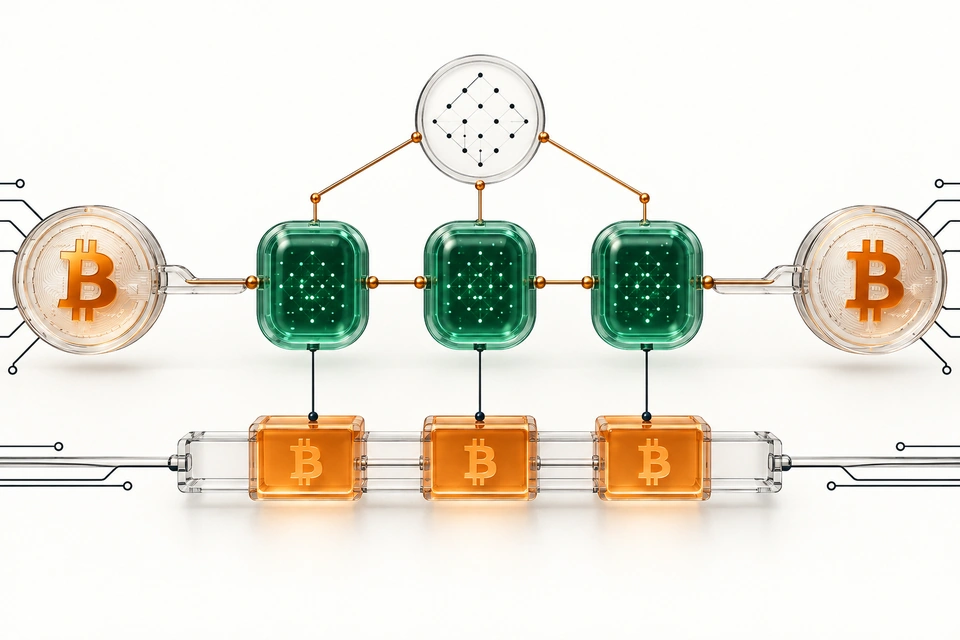
What has been proposed
In the Shielded Bitcoin design, the Bitcoin network records encrypted data and its ordering. Separate client software would reconstruct the state of the private layer, locate a user's notes, and verify proofs that a note has not already been spent.
The authors aim to conceal an amount, sender, and recipient inside that private layer. This differs from a standard Bitcoin transaction, where addresses, amounts, and input-output links are visible on the public chain.
Why no fork does not mean a new Bitcoin feature
A soft fork changes or adds rules enforced by network nodes. Shielded Bitcoin seeks to avoid that change: miners and ordinary Bitcoin nodes do not enforce its private-layer rules as consensus rules.
It is therefore more accurate to describe the work as a research overlay that uses Bitcoin as a data layer, not privacy built into Bitcoin itself. The proposal does not establish that the network now has a standard anonymous-payment mode.
The unresolved BTC entry and exit question
The specification focuses on private transfers between notes. A practical way to move ordinary BTC safely into the layer and back out needs additional mechanisms; publication of the paper does not create a ready user flow.
That distinction matters when reading the news: a cryptographic construction can be interesting without being a wallet, service, or deployed protocol. Practical use would require implementation, independent review, and clear risk models.
What it means for users now
As of publication, this is not an instruction to send BTC through a special method or a recommendation to use third-party tools with similar names. Check the domain, source code, key-custody terms, and legal status of any product promising private Bitcoin transfers.
For an ordinary operation, keep the usual checks: select the correct network, verify the destination address, fee, and amount received. Research news about privacy does not change the transparency of standard blockchain transactions or guarantee the safety of an unfamiliar wallet.