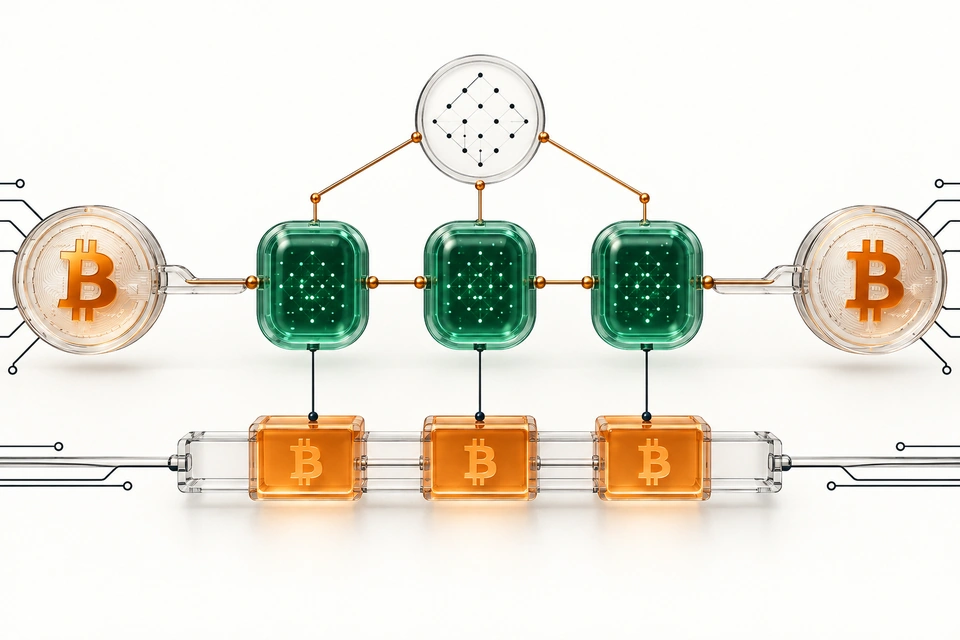
What changes during a hard fork
Blockchain nodes validate every block against a shared rule set covering transaction formats, block limits, script behavior, asset issuance and other conditions. A hard fork expands or otherwise changes those rules so that an old node cannot validate some blocks produced by upgraded participants.
This is different from a routine application update or copying a project's source code. A software fork can exist without its own chain, while a brief block fork can occur when producers find blocks at nearly the same time. Hard fork specifically describes an incompatible change to consensus rules.
Why a hard fork does not always create two networks
Developers normally schedule an activation block or time, release compatible clients and coordinate upgrades across nodes, validators, exchanges and infrastructure. If no economic community continues the old rules after activation, the network carries on as one chain under the new version.
A persistent split appears when some participants retain the previous rules and provide that branch with block production, nodes, wallets, liquidity and users. Technical potential and two viable networks are therefore different outcomes. The Bitcoin Developer Guide notes that a rule change can require a hard fork even when an actual chain split never occurs.
How a hard fork differs from a soft fork
A soft fork generally narrows the set of valid blocks. Old nodes do not enforce every new restriction, but they can still accept blocks produced under the stricter rules as valid under the older, broader rules. This is backward compatibility in block validation, not a promise that the update can simply be reversed.
A hard fork permits blocks or states that old nodes reject, so coordinated continuation requires participants to upgrade. Either process can cause a temporary divergence when activation is poorly coordinated. Adoption by wallets, services and the economic network matters alongside code and the share of block producers.
What Bitcoin Cash and The DAO demonstrate
On 1 August 2017, Bitcoin's chain split into Bitcoin and Bitcoin Cash amid disagreement over scaling parameters. Both sides retained separate rules, block producers, nodes and market infrastructure, turning the divergence into two persistent networks. This is a hard fork that did produce two supported chains.
On 20 July 2016, Ethereum activated the DAO Fork at block 1,920,000. EIP-779 describes an irregular state change that moved funds from contracts associated with The DAO into a recovery contract. Some participants continued the unforked chain, which became Ethereum Classic. The case shows that an incompatible decision can concern ledger state rather than a new block format.
What a hard fork means for coin holders
When two surviving branches share the same history before the split, one private key will usually control corresponding records on both networks. That does not guarantee automatic access to two assets. A custodial exchange may not support the new chain, a wallet may lack compatible software and distribution rules can vary.
Replay protection, the correct network identifier and trustworthy software also matter. A transaction sent on one chain may affect the other if signatures are not separated by the protocols. Users should wait for instructions from their wallet or service and never enter a seed phrase into an unknown application merely to claim a new coin.
- A hard fork changes consensus rules in a way old nodes cannot fully accept.
- Two coins emerge only when both chains retain lasting support.
- A soft fork keeps old nodes compatible with blocks produced under stricter new rules.
- A pre-fork balance does not guarantee wallet or exchange support for a new network.