The proposed state change
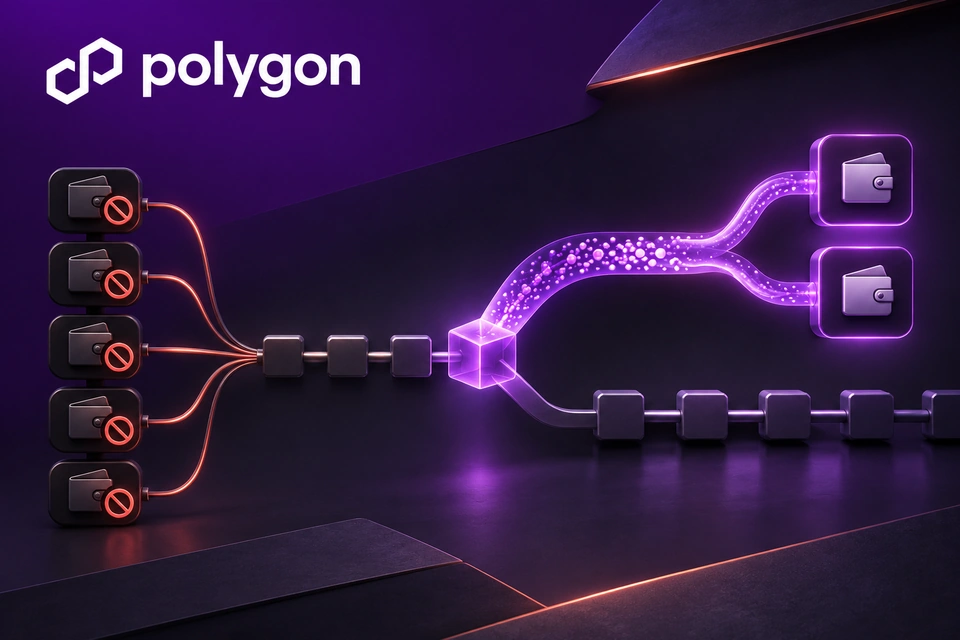
The Polygon Improvement Proposal posted on November 4 calls for a one-time balance adjustment at a fixed block on Polygon PoS. Each listed address would have its native POL balance set to zero, with the same amount credited to a designated recovery address. Total POL supply would not rise. Unlike an ordinary signed transfer, this would be executed by upgraded node software as a change to the chain's rules.
The draft identifies about 23.86 million POL across four addresses associated with the Polymarket incident and about 46.63 million POL at one address associated with the Binance incident. The combined 70.49 million figure is a working snapshot, not a final amount: balances would be checked again before any activation. The mechanism covers native POL only. It does not recover other assets, including USDT, that may be held at the addresses.
What the current blocklists cannot do
According to the PIP, Polygon Bor block producers already use transaction blocklists for the five addresses. That stopgap impedes movement, but it neither returns the POL nor amounts to a complete protocol-level freeze. The proposed fork addresses that narrower recovery problem, provided the community accepts the evidence and the exceptional intervention.
The two underlying incidents should not be treated as one attack. Polymarket's October 29 status report described a compromised monitoring script from a third-party vendor and malicious code targeting users. The Polygon proposal packages the balance recovery from that event and the separate Binance case into one state change; it does not establish a shared exploit path or common attacker.
Approval and testing still lie ahead
There is no approved activation block, mainnet date or final client release in the PIP. Its conditions include governance approval, incident postmortems that support the address attribution, continued blocklists until activation, proof of control over recovery addresses, and an Amoy testnet rehearsal. The authors say roughly two weeks after approval could be workable. That is a planning estimate, not a committed launch schedule.
The recovery proposal appears on the agenda for Polygon's November 5 governance call. An agenda item is not a vote result. Until the governance and implementation steps are complete, validators have no final activation rule to coordinate around.
The precedent and the operational risk
A balance reassignment without the senders' signatures would break with normal transaction-driven accounting and require a consensus change. Nodes that do not upgrade could split from the chain. Mistaken attribution or a compromised recovery address could send assets to the wrong party. Indexers and accounting tools would also need to represent a balance change that has no conventional transfer transaction.
The decision therefore turns on more than the headline value of the tokens: it tests what evidence is sufficient for an exception to ordinary balance finality. The PIP gives an indicative value of around $6.5 million using the October 29 POL price, not a fixed dollar reimbursement. The next verifiable milestones are a published governance decision, test results and precise activation parameters.