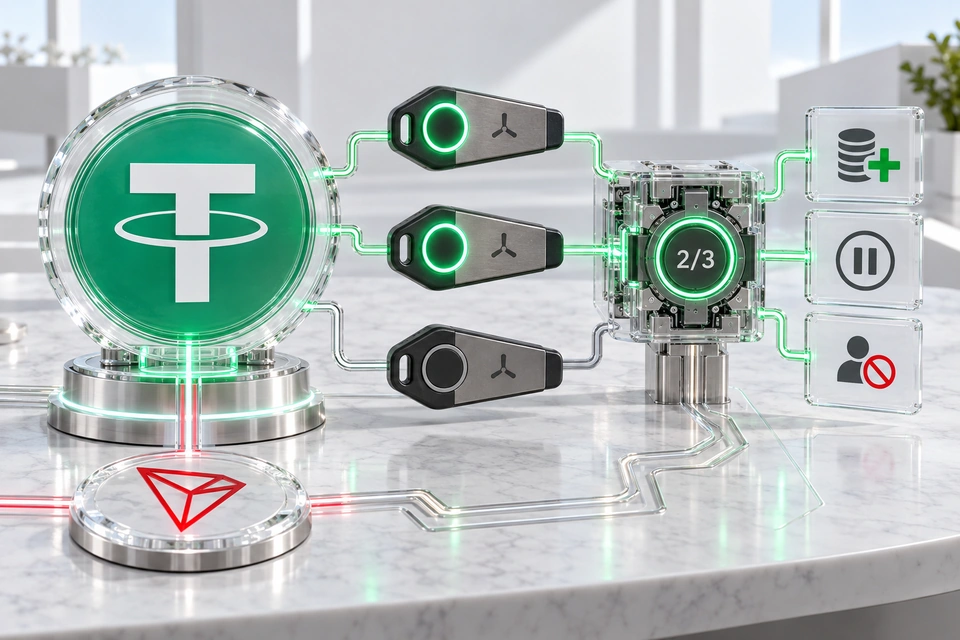
What the TRON blockchain confirms
The official TRC-20 USDT contract is deployed at TR7NHqjeKQxGTCi8q8ZY4pL8otSzgjLj6t. A read-only owner() call on September 10, 2026 returned TBPxhVAsuzoFnKyXtc1o2UySEydPHgATto. TRON's public getcontract method identifies that controlling contract as MultiSigWallet, and its published ABI exposes required and getOwners functions.
Calling required() returned 2, while getOwners() listed three different addresses. Any action submitted through this wallet can therefore execute once two signatures satisfy the threshold. The chain proves the address count and threshold, but it cannot reveal who physically holds each key, whether the custodians are operationally independent or which internal Tether procedures precede a signature. A 2-of-3 setup does not necessarily mean two separate employees acting alone.
Which powers sit behind the multisig
The TRON TetherToken ABI includes issue and redeem functions that change supply, pause and unpause controls for transfers, addBlackList and removeBlackList for address restrictions, and destroyBlackFunds for removing the balance of an already blacklisted address. It also exposes deprecate, setParams and transferOwnership. Because MultiSigWallet owns TetherToken, its confirmation threshold protects calls to those privileged functions.
At the time of review, totalSupply() reported roughly 94.26 billion USDT on TRON. That scale explains the operational concern: an error, abuse or simultaneous compromise of enough keys could affect the administrative layer of the token's largest single-network deployment. The existence of issue does not establish that unbacked tokens have been created. Matching new supply to reserves happens offchain and requires a separate financial assessment.
Two keys cannot arbitrarily take every balance
The administrative authority is broad, but it should not be described as universal wallet access. The verified interface contains no function that transfers an arbitrary balance from any holder directly to the contract owner. A normal transfer requires the holder's authorization, while transferFrom depends on an allowance granted in advance.
Tether can blacklist an address, pause transfers and destroy tokens held by an already blacklisted address. Destruction reduces the recorded balance rather than sending it to administrators. The practical effect for the user can still be severe because access to USDT may end through an issuer decision. Precise language matters: censorship, token destruction and theft are different mechanisms with different evidentiary requirements.
Why the absence of a timelock matters
Bluechip says Tether's privileged actions have no timelock. The published MultiSigWallet ABI likewise contains no separate delay mechanism: a transaction can execute after reaching the confirmation threshold. A timelock normally creates a window between approval and execution during which the issuer, exchanges and external monitors can detect a suspicious action and take protective measures.
Delay can limit some key-compromise scenarios, but it also obstructs emergency response. Tether uses freezing powers to meet legal and compliance demands where speed may be a deliberate system property. The missing timelock is therefore a tradeoff rather than standalone proof of a vulnerability. A more compartmentalized design could apply different roles, thresholds and delays to urgent freezes, minting, owner changes and code upgrades.
Hacken's assessment is not a report of an exploit
Bluechip added Hacken's methodology to its Implementation factor and upgraded USDT's overall rating from D to C on September 3. The action reflected more than technical architecture: it also followed a full audit of Tether International's 2025 financial statements, for which KPMG US issued an unqualified opinion. Stronger evidence about financial reporting does not remove key concentration, while technical risk does not automatically negate reserve quality.
Bluechip's public analysis describes capabilities and architecture, not a completed attack. The contract was not paused when checked, and the reviewed sources showed no compromise of two signing keys. The supportable conclusion is narrower than the source headline: a large share of USDT supply depends on a small administrative signature threshold, and users should evaluate that issuer risk alongside reserves, liquidity and network risk.
What TRON USDT holders should monitor
The first checkpoint is onchain: the owner address, required threshold, owners list, paused status and events that change owners or confirmation requirements. These values can change, so a one-time check is not permanent assurance. Official Tether disclosures about key policy, contract audits and the reasons for major administrative operations provide a separate source of context.
The second layer is offchain. Reserves, direct-redemption eligibility, service terms and custodian arrangements are not encoded in TetherToken. A holder using an exchange or self-custody wallet also relies on secondary-market liquidity. The 2-of-3 scheme shows who can administer the token technically, but a complete USDT risk review must combine code, financial reporting and the issuer's legal terms.