What the chain shows and what Hyperdash inferred
Hyperliquid makes account activity observable. Its official API supports queries for fills, portfolios, cumulative volume, open positions and the relationship between a master address and its subaccounts. Those records make it possible to reconstruct activity and check arithmetic for a defined address set without access to a firm's internal books.
Ownership is a separate question. A blockchain records an address and the actions authorized by its key, not the legal entity behind that key. Hyperdash attributes the analyzed accounts to Jump Trading through its own research, while Jump has not publicly confirmed this address set in the materials reviewed. The careful description is therefore accounts linked by analysts to Jump, not company-certified financial reporting.
$150 billion of turnover is not invested capital
Trading volume adds the notional value of executed transactions. The same capital can produce many times its value in turnover when a strategy repeatedly opens, reduces and reverses positions. That pattern is common in arbitrage, hedging and algorithmic execution. Nearly $150 billion should not be read as a deposit, portfolio value or net inflow to Hyperliquid.
Hyperdash's snapshot put the value of the analyzed accounts near $63.6 million and their open-position notional around $145 million. The analysts also estimated roughly $7 million in cumulative fees while trading profit remained in the hundreds of thousands of dollars. High turnover can produce that relationship, which proves neither exceptional profitability nor a large directional market forecast.
Why the linked accounts matter more in xyz markets
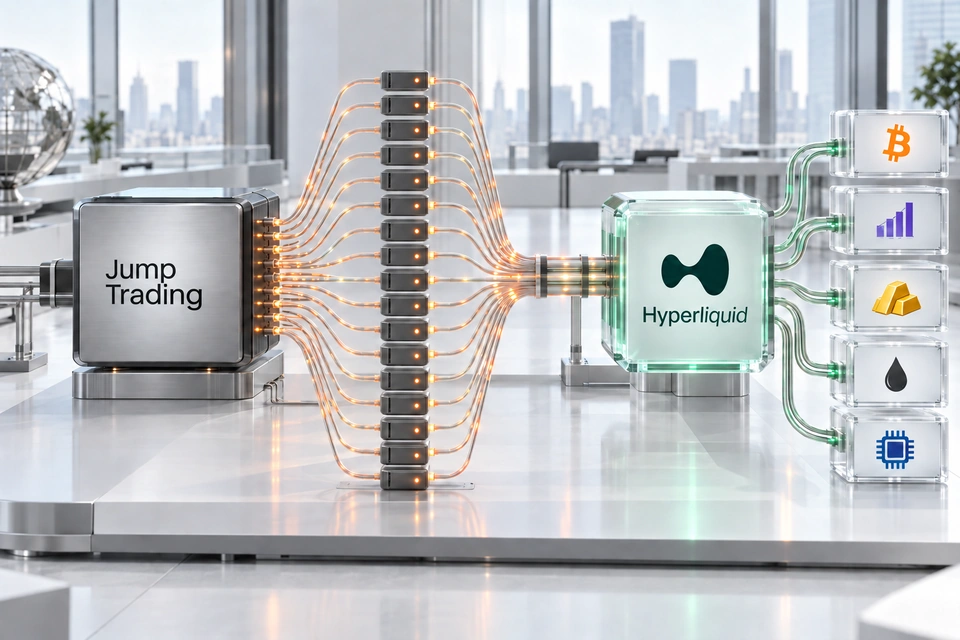
The linked accounts were estimated to represent 18.9% of xyz market volume, well above their 7.8% share across Hyperliquid perpetuals. Hyperdash calculated that the shares temporarily reached 28.7% and 17.9%, respectively, in July. Its mapping found separate subaccounts for oil, natural gas, metals, indexes, equities and new listings, while Bitcoin represented about 2.6% of the accounts' volume.
That composition is more informative than the headline total. Hyperliquid lets third-party builders launch perpetual markets through HIP-3, including instruments that reference traditional assets. Official documentation assigns the market operator responsibility for contract design, price-oracle definitions and operating parameters. A large trading firm can add turnover and opposing orders, but it does not remove oracle, liquidation or market-specific rule risk.
Fees create value while concentration creates dependence
Hyperliquid determines fee tiers from rolling 14-day volume, with subaccount activity counted together with the master account. Platform documentation says fees flow to HLP, the assistance fund and individual market deployers. If the analyzed accounts mostly cross existing orders as takers, their repeated execution directly creates fee revenue.
One participant's turnover is not the same as resilient platform-wide liquidity. When a substantial share of trading comes from one linked group of accounts, its departure can reduce volume, fees and depth in selected instruments at the same time. The 18.9% xyz share indicates that sensitivity, but does not by itself prove manipulation or price control. That conclusion would require order-level evidence, counterparty analysis and measured market impact.
What Jump's scale says about onchain market development
Jump Trading describes itself as a global trading firm operating across asset classes with its own technical infrastructure. Jump Crypto likewise identifies trading as part of its activity alongside blockchain engineering. If Hyperdash's attribution is correct, splitting the operation across 16 subaccounts looks like a way to isolate strategies and market risk, not one enormous directional trade.
The broader signal is infrastructural. Public onchain accounts can now support complex multi-market operations that were difficult to observe outside centralized venues. Transparency helps verify volume and positions, but does not reveal external hedges. A short on Hyperliquid may offset a purchase on another exchange or traditional venue, so one visible position does not describe the firm's full exposure and is not a trading signal.
How to read large onchain accounts without false conclusions
Start by separating cumulative turnover, current position notional and account equity. Then examine maker versus taker activity, fee costs, open interest and order-book depth. High volume with limited net profit may describe hedging or arbitrage rather than a conviction trade on the direction of one asset.
Finally, every owner label needs a source and timestamp. Addresses can change hands, trading structures evolve, and one organization may use several venues simultaneously. Hyperdash's work provides a useful Hyperliquid snapshot as of September 8, 2026, but it does not establish an official partnership, guarantee future volume, or make HYPE and the traded contracts less risky.