What Strategy actually reported
The September 8 Form 8-K records three separate facts for the reporting week: no ATM sales, no bitcoin transactions, and $176.3 million spent on STRC repurchases. This does not amount to an abandonment of the bitcoin strategy. It is one capital-allocation period inside the company's broader Bitcoin Treasury Company model.
Holdings therefore remained at 845,050 BTC. Strategy reported an aggregate acquisition cost of $63.73 billion and an average cost of about $75,412 per BTC, including fees and expenses. One week earlier, it had disclosed a purchase of 4,603 BTC for $369.7 million. The latest filing shows a change in priority between adjacent periods, not yet a durable policy reversal.
Why the STRC repurchase was attractive
STRC, formally the Variable Rate Series A Perpetual Stretch Preferred Stock, is perpetual preferred equity with a variable dividend rate and a $100 stated amount per share. Strategy previously set an objective for STRC to trade around $99 to $100 and said repurchases below that range could support the price while reducing future preferred-dividend requirements.
Dividing the reported $176.3 million by 1,810,885 repurchased shares gives an approximate average of $97.36 per share. The calculation uses a rounded aggregate figure, but it indicates a discount of roughly 2.6% to the $100 stated amount. Strategy can move the security closer to its target range while retiring an obligation below its notional base.
The buyback was not funded by selling bitcoin
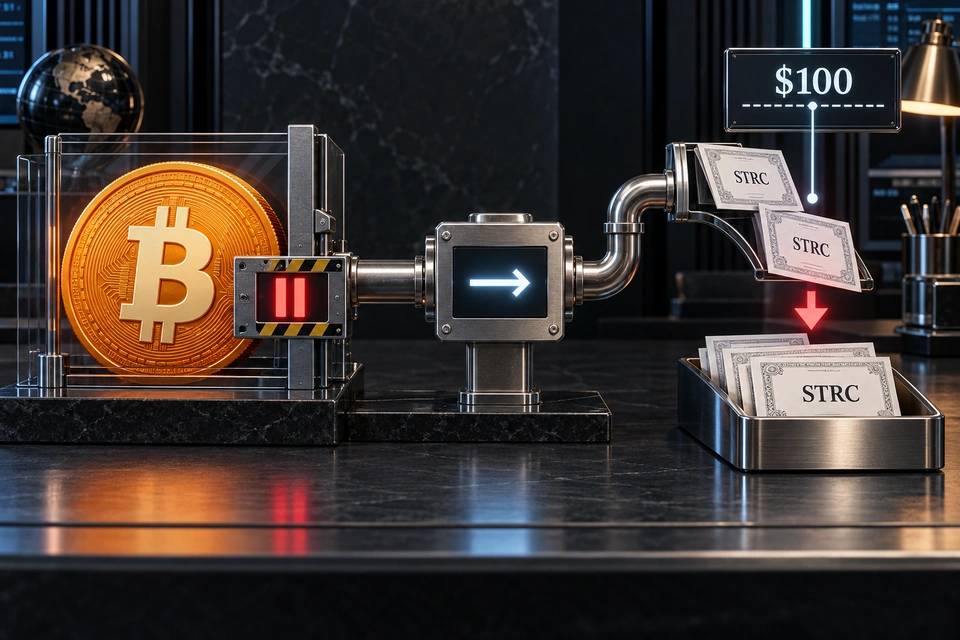
The choice between BTC and STRC needs careful wording. Strategy explicitly said the repurchase was funded from USD Cash and that no bitcoin was sold during the week. The filing therefore does not show BTC being converted into STRC shares, nor does it prove that the same $176.3 million had previously been earmarked for a bitcoin purchase.
Strategy separates dollar liquidity into two categories. The USD Reserve is intended to support preferred dividends and interest on outstanding debt. USD Cash has a broader purpose that can include buying bitcoin, adding to the reserve, capital management and similar corporate uses. As of September 7, the USD Reserve was $5.10 billion and USD Cash stood at $1.44 billion after the STRC transaction.
A $2 billion authorization is not a $2 billion purchase
The board increased the authorized aggregate purchase price under the Digital Credit Securities Repurchase Program from $1 billion to $2 billion. The figure includes fees, expenses and all repurchases already completed under the program. Strategy reported $1.19 billion of capacity remaining as of September 7.
Authorization provides flexibility but does not require the company to deploy the full amount immediately. Future activity will depend on the market prices and liquidity of STRC and other preferred issues, available capital, legal requirements and the relative appeal of buying bitcoin. The headline limit should therefore not be added to the $176.3 million as money already spent.
What changes for STRC and MSTR holders
For STRC holders, repurchases reduce the number of shares outstanding and the future dividend bill if the shares are retired or held without reissuance. Buying below $100 also demonstrates that Strategy is willing to allocate capital toward its stated trading objective. It does not guarantee the market price or remove interest-rate and credit risk.
For MSTR holders, the transaction highlights competition among several uses of corporate capital: bitcoin purchases, dollar liquidity, servicing obligations and management of the company's own securities. Strategy repurchased no MSTR shares during the period, and the separate common-stock repurchase program still had its full $1 billion authorization available.
The week's main signal
Skipping a BTC purchase for one week is not inherently a bearish signal. Strategy retained its entire bitcoin position and used part of its dollar liquidity for a transaction management considers attractive when STRC trades below stated amount. This is two-way capital management: issuing securities and buying BTC can be complemented by repurchases when the company's own obligations trade at a discount.
The next filings will show whether this was a one-off response to the discount or the start of a longer repurchase cycle. The relevant indicators extend beyond new BTC purchases to the STRC repurchase price, remaining USD Cash, changes in the USD Reserve and any resumption of ATM sales. Reading them together reveals the actual opportunity cost of each capital decision.