What the reports establish about India's proposal
Bloomberg reported that India wanted broader use of CBDCs without backing a common network that could be seen as a challenge to the dollar. Reuters independently described the proposed links and obstacles to implementation. It also said requests for comment sent to Indian ministries and the Reserve Bank of India had gone unanswered.
India's foreign ministry confirmed September 12 and 13, 2026 as the dates of the New Delhi summit. The agency reports concern discussions ahead of that meeting. They should not be rewritten as confirmation that members have approved access rules, launched a platform or fixed a commercial start date. An idea, an agreed document, a pilot and a live payment route are different milestones.
Connecting CBDCs does not create a common currency
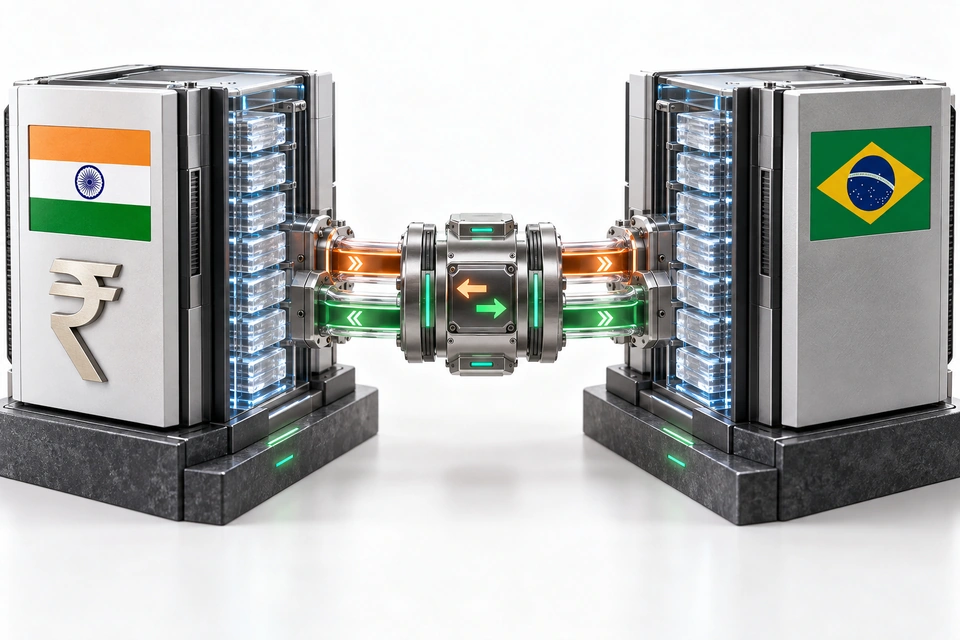
A CBDC is a liability of the central bank that issues it. A digital rupee and another country's digital currency retain separate issuers and units of account. A connection can support exchange and transfer without creating a shared central bank, a single exchange rate or a new monetary asset.
The RBI's CBDC concept note treats interoperability as a legal, foreign-exchange and access-governance problem as well as a technical interface problem. That provides official design context, not confirmation of a particular BRICS architecture. Nor does discussion of CBDC links establish that an international network would accept any crypto wallet, Bitcoin or a privately issued stablecoin.
A digital bridge still needs foreign-exchange liquidity
Paying in another currency requires someone willing to accept the sender's money and provide the recipient's currency. Reuters specifically cited a source saying currency-swap arrangements would be needed to manage trade imbalances. Software connectivity cannot manufacture the required currency inventory or eliminate its economic cost.
The BIS Icebreaker experiment, published in March 2023, offers a useful illustration. Its model divides a cross-border transaction into two domestic payments, with an FX provider operating in both systems. Each CBDC remains within its own ledger. Coordinated payment-versus-payment settlement links the two legs, reducing the risk of sending one currency without receiving the other.
Icebreaker is not an announced BRICS system. It demonstrates a design possibility rather than a service that businesses can necessarily use. A live corridor would still need admitted participants, liquidity, legally effective settlement and procedures for failed transactions. A working technical connection is only one component of that arrangement.
The details businesses need before using a new route
BIS discussions distinguish bilateral links from shared multi-currency platforms. Bilateral arrangements may face scaling constraints, while common platforms require more complex joint governance. It would therefore be premature to claim that a bilateral bridge is always simpler or cheaper. The result depends on domestic designs and the rules participants can agree on.
Businesses need concrete answers: which banks can participate, which currency pairs are supported, who quotes the exchange rate, what fees apply and when a payment discharges the underlying obligation. Identification requirements, error handling and refunds matter too. Until those terms are published for a specific corridor, reports of negotiations should not be treated as a ready payment service or a reason to buy a supposedly connected token.