
Checking the record against adjustments
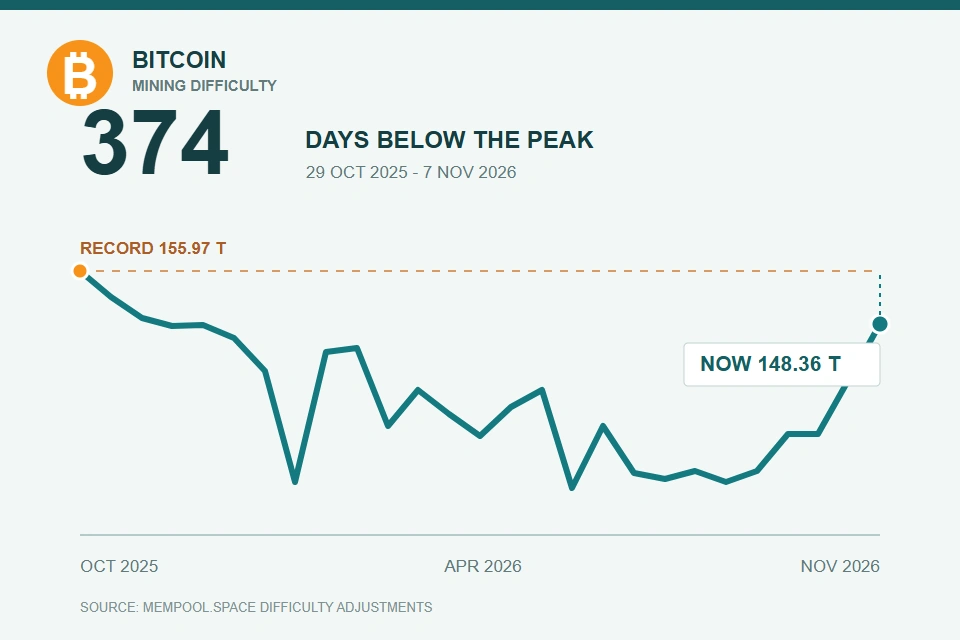
Mempool.space records difficulty of 155.973 trillion at block 921,312 on October 29, 2025. The most recent completed adjustment, at block 973,728 on October 29, 2026, raised difficulty by 5.54% to 148.365 trillion. No intervening adjustment exceeded the earlier high. This comparison uses actual retarget values, not a daily estimate of hashrate.
The longest previously completed span between difficulty highs was about 364 days, from August 1, 2011 to July 30, 2012. The current span is still open, so its final length is unknown. The 374-day figure is a November 7 snapshot; it will keep increasing until a new record is set.
How the gap affects mining
Bitcoin retargets difficulty every 2,016 blocks to bring the average block interval back toward ten minutes. Difficulty responds to how quickly recent blocks were found; it is not a direct count of active ASIC machines. If computing power falls, a later retarget makes blocks easier for the remaining miners to find. If power recovers, difficulty rises again.
At 148.36 trillion, the current setting is only 4.88% below the all-time high. A fresh record is not required for the network to operate: miners continue to produce blocks and transactions continue to confirm. For an individual operator, profitability also depends on its share of hashrate, electricity prices, machine efficiency, transaction fees and BTC's market price.
What the number cannot prove
A long stretch below a peak does not by itself prove that miners have broadly moved into AI data centers, that network security has fallen by 4.9%, or that bitcoin's price must move in a particular direction. Establishing causes requires separate evidence about hashrate, costs, machine shutdowns and operators' decisions. One company's announcement is not a network-wide measurement.
The next retarget could narrow or widen the distance from the peak. Forecasts made before the epoch ends change as the remaining blocks arrive at unpredictable times. The verified observation today is narrower but meaningful: the old difficulty record has lasted more than a year, even though difficulty has partly recovered from its decline.