What Twenty One Capital filed with the SEC
Twenty One Capital attached a transcript and slides from Zagury's August 28, 2026 Bitcoin Asia keynote to an SEC filing. The presentation estimates an all-time high of 1,275 EH/s on September 19, 2025 and places the network in the high 900 EH/s range at the time of the talk. It calculates a drawdown of roughly 22% to 24% and describes the period as the longest stretch without a new high in a decade.
The wording matters: the slide says the network may be in its first real hashrate bear market. That is management's analytical classification, not a protocol state. Bitcoin does not announce the beginning or end of such a market. Observable inputs are blocks and difficulty, from which computing power is estimated statistically.
Why services report different hashrate peaks
The network's exact aggregate hashrate is unknown because nodes see successful blocks, not every ASIC attempt. Services infer it from the rate of block production and current difficulty. Blockchain.com notes that daily figures can move sharply because block discovery is random even when underlying power is constant, and recommends a seven-day average as a better representation.
In the one-year Blockchain.com series retrieved on September 2, the seven-day average peaked near 1,152 EH/s on October 19, 2025 and stood around 923 EH/s on September 1, 2026. That is a decline of almost 20%. The peak is lower and one month later than Twenty One Capital's figure because the series use different windows and smoothing. They show the same direction, but their numbers should not be combined as if they came from one dataset.
What makes miners switch ASICs off
An operator's revenue depends on its share of total hashrate, the block subsidy and fees, bitcoin's price and operating costs. When hashprice is weak, older power-hungry ASICs are the first to stop covering electricity. Twenty One Capital contrasts today's gradual decline with the abrupt 2021 shock: machines displaced by China's mining ban could be moved, whereas some current machines are being disconnected because their economics no longer work.
Difficulty supports the evidence of pressure, although it moves more slowly than estimated hashrate. Blockchain.com's series shows about 125.81 trillion on September 1, down from 129.70 trillion one year earlier, or approximately 3%. The protocol retargets every 2,016 blocks to bring the average interval back toward ten minutes. When power leaves, a lower difficulty increases the remaining machines' share of rewards.
- BTC price determines the dollar value of a miner's reward.
- Difficulty and total hashrate divide fixed issuance among operators.
- ASIC efficiency and electricity cost set the shutdown threshold.
- Debt, site leases and maintenance widen the gap between companies.
How AI data centers compete with mining
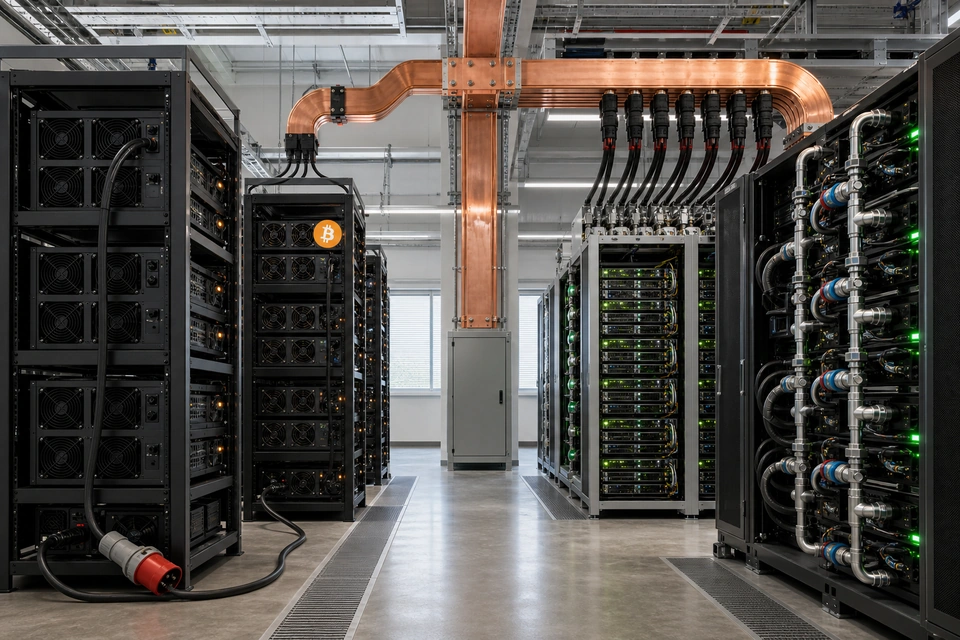
The AI link is visible at specific public companies. IREN's annual report says that during fiscal 2026 it began decommissioning bitcoin-mining hardware and reallocating power and data-center capacity toward AI Cloud Services. Its installed mining capacity was 23.2 EH/s across about 380 MW on June 30, and it aimed to substantially complete the transition by December 31, 2026.
That filing confirms a structural shift but cannot attribute the entire network decline to AI. Powerful GPUs need different hardware, networking and cooling, and not every mining site can be converted quickly. A lower bitcoin price, compressed hashprice, regional restrictions and seasonal load management are operating at the same time. AI and HPC are better understood as new competitors for capital, grid connections and ready-to-use megawatts.
What the decline changes for the network and miners
Lower hashrate means less aggregate work for a potential attacker to match, so the direction matters for security. Current levels in the hundreds of EH/s still represent an enormous base of specialized infrastructure. Difficulty adjustment helps maintain block production, but it does not replace departed defensive computing power or guarantee profitability for every operator.
Efficient miners may benefit from the contraction. After a difficulty retarget, existing machines receive a larger share of rewards, while competitors' hardware and power contracts may become cheaper. Recovery need not follow the 2021 pattern. It will depend on bitcoin's price, fees, new ASIC generations, power costs and whether long-term AI/HPC contracts remain more attractive than mining. Twenty One Capital's thesis is useful as a description of the market regime, not proof of one cause or a reversal forecast.