What the U.S. Treasury announced
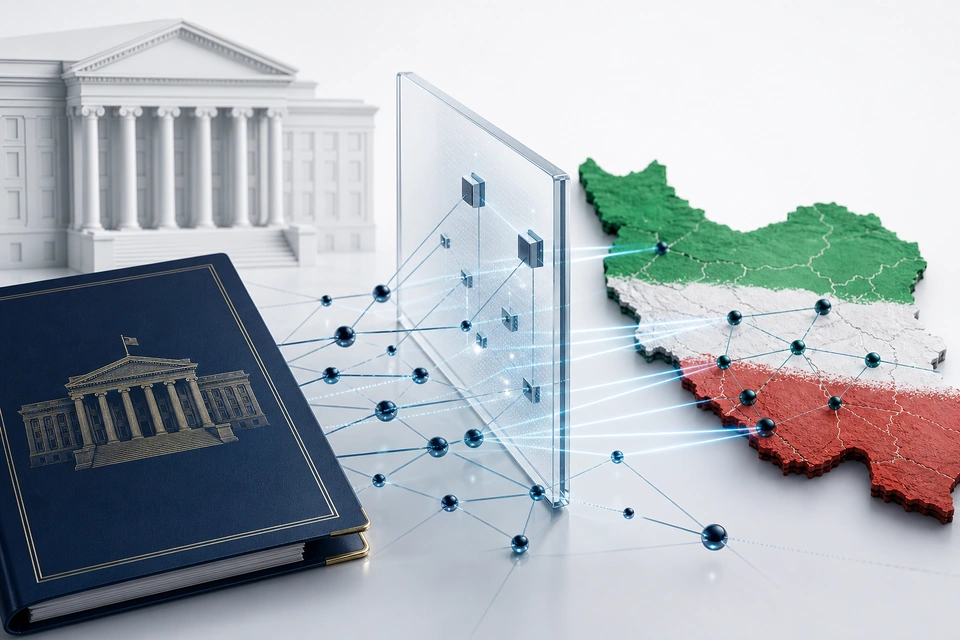
Treasury presented the campaign as a coordinated package aimed at Iran's financial channels. OFAC simultaneously issued five sectoral determinations under Executive Order 13902. They extend the government's ability to designate foreign persons that operate in the identified sectors of Iran's economy or provide material services in support of them.
Digital assets are now explicitly named as one of those five sectors. Treasury says the measure responds to cryptocurrency use for sanctions evasion and transactions linked to the Islamic Revolutionary Guard Corps and Iranian officials. That is the U.S. agency's stated basis for the action, not a finding that every crypto activity by an Iranian person has the same status.
A sectoral determination is not a blanket block
The legal mechanism is the central distinction. A sectoral determination gives OFAC authority to designate people and organizations operating in the relevant sector. It does not by itself place every Iranian exchange, broker, developer and wallet on the Specially Designated Nationals List. Blocking consequences for a specific party generally require a separate designation or another applicable prohibition.
It would therefore be too broad to say that the United States banned all Iranian cryptocurrency activity. A counterparty's exact status must be checked against current sanctions lists, applicable executive orders and identifiers published by OFAC. Jurisdiction, ownership, the service provided and connections to an already blocked person can all affect the analysis.
Nearly 60 designations formed a separate package
On the same day, OFAC sanctioned nearly 60 entities, individuals and vessels across several jurisdictions. The agency linked them to procurement of technology for missile and nuclear programs, malicious cyber operations, oil-revenue networks and other activity. Those designations rely on several executive orders and are legally distinct from naming digital assets as a sector.
The distinction matters when interpreting the announcement. The new sectoral framework broadens the group that may face measures in the future, while an entry on a sanctions list creates consequences for a party that has already been identified. A shared announcement date does not turn every part of the package into a blanket sanction on the crypto market.
What changes for crypto services
Exchanges, payment platforms, custodians and analytics providers may need to assess client and transaction links to Iran's digital-asset sector more closely. Core controls include screening names and businesses against current OFAC lists, reviewing published wallet identifiers, checking ownership and beneficial control, and examining activity that may amount to material support for a blocked person.
For U.S. persons, property of blocked parties that is in the United States or under their possession or control must generally be blocked and reported under OFAC rules. Non-U.S. businesses may also consider secondary-sanctions exposure. Compliance is not just a geographic filter, however: an IP location or a reference to Iran does not replace counterparty, ownership and payment-purpose analysis.
What is confirmed and what remains uncertain
The official package confirms the broader authority and nearly 60 specific designations. It does not automatically prove claims about every individual Iranian exchange, wallet or payment method. Such claims require separate support in OFAC releases, sanctions records or law-enforcement documents.
The practical reach will become clearer as OFAC makes further designations and publishes guidance. Until then, three layers should remain separate: the political campaign announcement, the legal sectoral determination and specific sanctions-list entries. The last layer identifies who is already named, while the first two show the direction of future enforcement.
- Digital assets are one of five newly identified sectors of Iran's economy.
- The determination expands OFAC authority but does not automatically block Iran's entire crypto market.
- The nearly 60 designations announced the same day are separate, specific sanctions actions.
- Crypto services should assess lists, ownership, wallet identifiers and the nature of support rather than rely on geography alone.