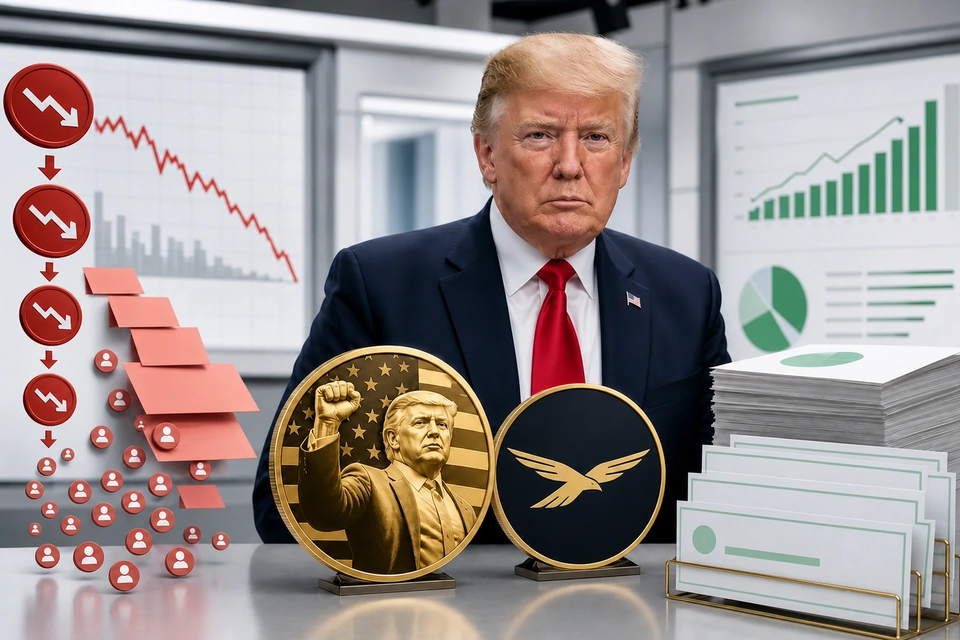
What makes up the $4.7 billion estimate
Public Citizen's 27 August 2026 report divides the total among five products. It assigns about $3.2 billion to the TRUMP meme coin, at least $1 billion to the WLFI governance token, $450 million to the paper loss on Trump Media's bitcoin treasury and another $9.3 million to the decline in aggregate value of three Trump Digital Trading Cards editions. The authors found no comparable holder loss for the USD1 stablecoin.
Those entries can be added arithmetically, but they are not economically uniform. TRUMP and part of the WLFI estimate use wallet-level profit and loss, the NFT calculation compares original sale proceeds with recent secondary-market prices, and the Trump Media figure compares bitcoin acquisition cost with quarter-end value. The result is neither a single audited loss ledger nor a total of verified investor claims.
Public Citizen is a consumer advocacy and lobbying organization, and the report includes political and regulatory recommendations. The $4.7 billion figure should therefore be described as the organization's estimate under its stated methodology, not an official damage award, a court finding or a regulator's calculation. Its value lies in the disclosed categories and methodological limits.
Why TRUMP accounts for most of the total
At Public Citizen's request, analytics firm Nansen examined TRUMP purchases on Solana decentralized exchanges. After filtering for addresses it classified as likely retail wallets, the sample contained about 1.6 million wallets. Roughly 1 million, or 65%, were underwater by a combined $3.2 billion. Realized losses were estimated at about $400 million, so most of the headline amount could still move with the token's price.
The results were highly concentrated. Data cited in the report says the top 1% of profitable wallets captured about $2.7 billion, or 80% of all gains. Wallets that bought during the first two days collected almost 90% of gains. For a meme coin, entry and exit timing can therefore matter far more than the total number of holders or the fame of the associated brand.
The analysis has boundaries. One address does not always equal one person, and one participant can control many addresses. The sample covers Solana DEX activity but cannot provide a complete result for centralized exchanges or each owner's positions in other assets. An unrealized loss also does not mean the holder has sold and permanently crystallized that amount.
What the reported $1.4 billion in income means
On 30 June 2026, the U.S. Office of Government Ethics released Donald Trump's certified annual financial disclosure for 2025. Public Citizen grouped entries it classified as crypto-related and arrived at at least $1.4 billion. Its reconstruction includes about $635 million in TRUMP licensing fees, $527 million from WLFI token sales, $65.6 million from a World Liberty Financial equity sale and roughly $199 million in other venture and USD1-related receipts.
An OGE form discloses assets, ownership interests and types of income through legal entities, but income on the form is not always the same as personal net profit after expenses and taxes. Some entries concern companies whose economic rights are divided among entities and family members. The statement that Trump received $1.4 billion therefore needs the same qualification: it is the report's classification of disclosed receipts, not a personal bank-account statement.
The disclosure does confirm the underlying economic links. It lists CIC Digital, interests in World Liberty Financial structures, WLFI tokens and related revenue rights. The official TRUMP website also says CIC Digital and Fight Fight Fight LLC jointly control 80% of the initial token supply under an unlock schedule. These records allow ownership and incentives to be examined separately from estimated market losses.
How investors should read comparisons like this
The first question for any large loss number is whether it has been realized. A sale below cost crystallizes a loss, while a negative mark on an open position changes with the market. The second question is who is in the sample. DEX addresses, centralized exchange accounts, NFT holders and shareholders of a listed company require different data sources and should not automatically be treated as one investor population.
Celebrity-linked tokens also require attention to supply distribution, unlock dates, rights held by related companies and market depth. Control of a large allocation does not prove a future sale, but it creates potential overhang. A high nominal valuation likewise does not mean the entire position could be sold at the latest quoted price without materially affecting liquidity.
The report does not produce a price forecast for TRUMP or WLFI. It highlights the gap among issuer and licensing revenue, returns captured by early wallets and the outcome for later buyers. Before trading, checking the official contract, token allocation, unlock schedule, liquidity and the methodology behind any profit statistic is more useful than relying on political fame or a single aggregate loss headline.