What Orionx officially confirmed
On September 3, Orionx told customers that it had started a definitive closure. Its official statement attributed the decision to an external forensic audit that allegedly identified transactions moving assets held in custody to wallets the exchange did not manage. Orionx put the value of those operations above $7 million and said it had submitted the evidence to Chilean prosecutors.
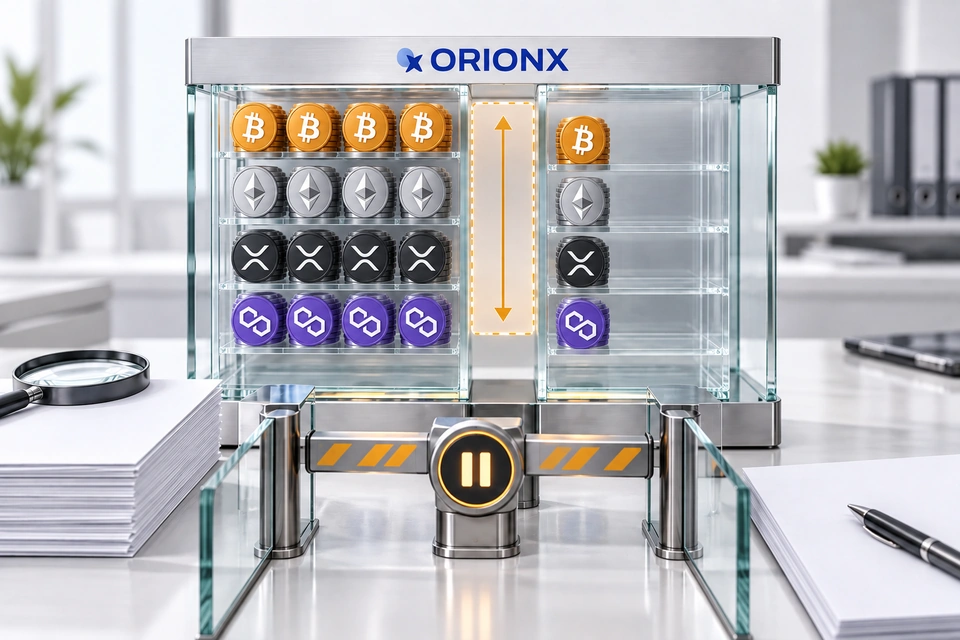
The exchange temporarily suspended withdrawals. It says the pause is intended to treat customers equally, preventing faster claims from being satisfied at the expense of others. Orionx is preparing a closure and restitution process, but it has not publicly guaranteed that every balance will be repaid in full or given a precise payment schedule.
Orionx also warned that its staff will not ask for passwords, private keys, two-factor authentication codes or a transfer of funds. During a shutdown, impersonation scams can compound customers' original losses.
The audit found a ledger-custody mismatch
According to Chilean newspaper La Tercera, the external review compared Orionx's internal liabilities ledger with balances visible on public blockchains. The complaint lists shortfalls of roughly $3.93 million in BTC, $2.29 million in ETH, $762,000 in XRP and a small amount of POL. Those categories total about $6.98 million, while the company's public statement describes transactions above $7 million.
The differing figures mean the final loss and recoverable assets are not yet public. The complaint also describes alleged transfers from 2018 through 2021, including 79 BTC and large stablecoin amounts. These are assertions by the complainant, not court findings.
The episode illustrates the central risk of a custodial platform: a number displayed in an account is a claim against the operator, not proof that the corresponding asset sits in a segregated wallet. A public blockchain can help verify disclosed addresses, but it does not expose the complete internal liabilities of a private company.
The allegations are not findings of guilt
Orionx's criminal complaint names former executives and co-founders Joaquín Díaz and Roberto Zibert, linking them to some of the disputed activity. Filing a complaint starts an investigation; it does not establish guilt. The destination of the assets, each participant's authority and the legal characterization of the transfers remain questions for the competent authorities.
Díaz and Zibert have categorically denied the accusations. In their public response, they said they never acted against customers' interests and that the cause of the shortfall has not been conclusively determined and should be resolved through an independent investigation. The accurate description is therefore a reported deficit and competing claims, not a completed case.
That distinction matters to customers. A criminal investigation, asset recovery and a distribution procedure can move on different timelines and under different rules. Even proof of particular transfers would not automatically produce full or immediate repayment of every customer claim.
The CMF is not supervising restitution
Chile's Financial Market Commission, the CMF, clarified on September 4 that Orionx is not under its supervision and that the commission is not overseeing the company's announced shutdown. This qualifies Orionx's statement that authorities were informed about the plan: notifying an authority does not amount to regulatory approval or government management of repayments.
The regulatory context predates the closure. On June 26, the CMF rejected Orionx SpA's registration and authorization under Chile's Fintech Law because the company had not cured observations or supplied information needed to verify compliance. Once the transitional authorization ended, the platform could conduct only actions required to wind down existing operations.
The absence of CMF oversight over restitution does not preclude involvement by prosecutors or courts, but customers should not treat the process as regulator-guaranteed. Current operational instructions must come from Orionx's official channels, while an individual customer's legal rights depend on the contract and applicable law.
Tether's investment was not deposit insurance
In June 2025, Tether announced a strategic investment in Orionx and led its Series A round. That relationship explains why coverage describes Orionx as Tether-backed, but an equity investment does not turn the investor into an insurer of customer balances or by itself establish control over the exchange's daily operations.
Available statements contain no public commitment by Tether to cover the shortfall. A prominent investor's logo cannot substitute for checking authorization, custody arrangements and repayment terms. Reputational association and liability for a company's debts are different concepts.
Users of any centralized exchange should establish who holds their assets, whether customer property is segregated, whether reserves and liabilities can be verified, and which authority can hear a complaint. Neither a major investor nor an earlier audit eliminates operational and custody risk.
What Orionx customers should do now
Customers should preserve account statements, balance screenshots, request history, transaction IDs for deposits and withdrawals, support correspondence and contractual documents. It is prudent to record this material now rather than assume permanent access to the account. Instructions should be checked by manually opening Orionx's official website and status page, not through links in unexpected messages.
Do not disclose a seed phrase, private key, password or 2FA code, and do not send additional funds to supposedly unlock a withdrawal. A legitimate restitution process does not require the key to a self-custody wallet. Suspicious emails and accounts can be retained as evidence, but customers should not reply or install any remote-access software they offer.
Customers should monitor the official claims procedure while recognizing that the timing and recovery percentage remain unknown. For a material balance, advice from counsel familiar with Chilean law and cross-border claims may be appropriate. This article provides general security information, not individualized legal advice.