The components of the reported loss
Revenue for the first nine months rose 30.5% year over year to ¥5.895 billion, while operating profit increased 26.5% to ¥3.476 billion. Net profit attributable to owners of the parent had been ¥13.528 billion in the comparable 2025 period. The change in the bottom line therefore does not mean the operating business had no income. Bitcoin transactions and valuation had a large effect below operating profit.
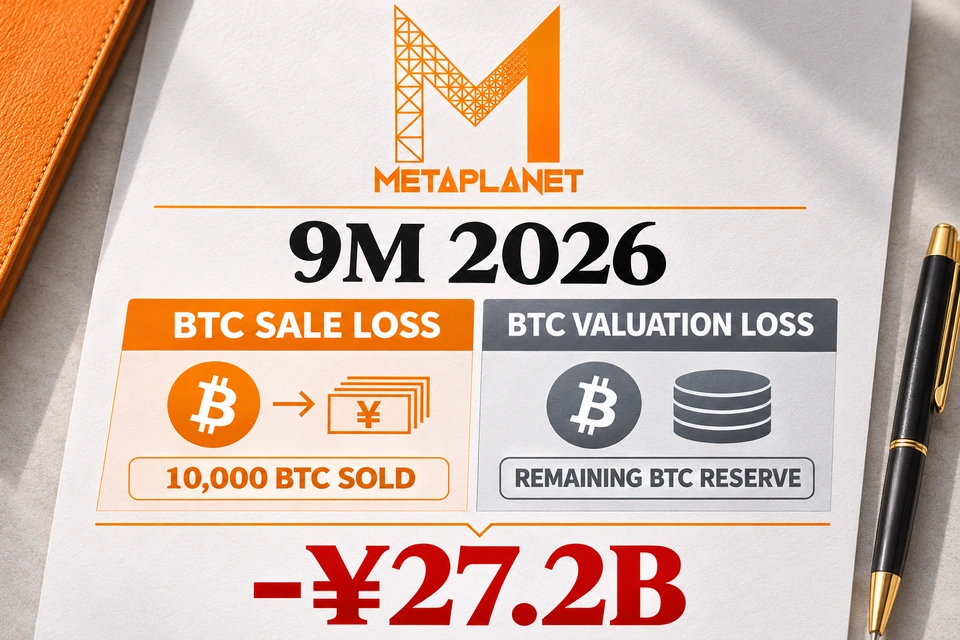
Metaplanet's presentation shows proceeds of ¥124.7 billion from BTC whose carrying amount was ¥143.9 billion, resulting in an approximately ¥19.2 billion realized sale loss. A further roughly ¥8.0 billion reflects the period-end valuation of Bitcoin still held. That valuation charge is not a sale of those coins or an equivalent cash payment. The two amounts are close to the reported net loss, but they are not a complete calculation of profit after other items and taxes.
The 10,000 BTC sale did not reduce closing holdings
During the third quarter Metaplanet sold 10,000 BTC and later acquired 11,000 BTC in a separate transaction. It disclosed that sequence on October 5, describing it as a demonstration that a large holding could be converted into liquid assets for the benefit of creditors and potential investors. The November earnings report explains the accounting effect of that earlier transaction; it does not announce a fresh 10,000 BTC sale in November.
The company held 44,000 BTC at September 30, up from 43,000 BTC at the end of June. A net increase of 1,000 BTC does not erase the loss recorded on the first sale: the sale is measured against the carrying value of the coins disposed of, while the subsequent purchase is accounted for separately. Nor does the closing balance imply that every coin was acquired at one price.
Realized loss and valuation loss are different
A realized sale loss arises when an asset is disposed of for less than its carrying value. A valuation loss arises when the period-end measure of an asset still on the balance sheet falls below its previous accounting value. Both affect Metaplanet's reported results, but only the sale generated proceeds and removed specific BTC from its holdings.
That distinction matters when assessing Bitcoin treasury companies. A net accounting loss should not automatically be treated as a matching cash shortfall; equally, a large BTC reserve does not eliminate funding risk. Future asset values, financing terms and operating results can change independently of the nine-month figures.
What the next reports will need to show
Metaplanet revised its full-year 2026 revenue forecast from ¥16 billion to ¥6.5 billion and its operating-profit forecast from ¥11.4 billion to ¥3 billion. Citing Bitcoin volatility, it did not provide a forecast for ordinary profit or net income. Those figures are management estimates, not completed annual results.
Future disclosures should be read by separating BTC units held, cash received and spent, mark-to-market changes and financing costs. The ¥27.157 billion loss describes the nine months already ended in September 2026. On its own it does not show that Metaplanet must sell Bitcoin to meet obligations, and it is not a forecast of the coin's price.