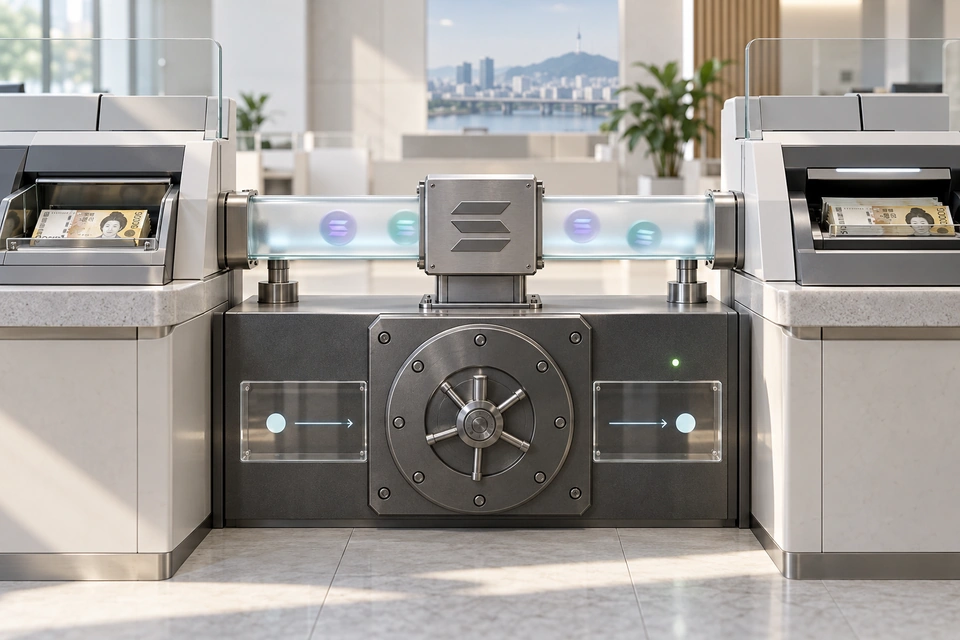
The remittance path the bank tested
The PoC modelled a bank-run international remittance flow: a Korean won deposit, conversion to a stablecoin, escrow placement, settlement inside the channel, and payout through a local receiving bank abroad. Korean outlet edaily reported that the scenario was based on remittances by foreign workers in Korea to their home countries.
An important detail is that the exchange was handled in a custody environment controlled by the bank rather than through an external cross-chain bridge. That describes the test model; it does not establish that a standing public service is ready or that any specific token is available to customers.
What a private Solana channel means here
In the published account, movements inside the private channel were not written to the public network in full. Deposits and final settlement outcomes were intended to appear on the public layer, while counterparties and amounts were not exposed as ordinary transfers on an open blockchain.
That is not the same as anonymity. Privacy from public observers does not remove bank recordkeeping, access rules, or customer-identification requirements. Solana also notes that its standard Confidential Balances feature hides amounts, but does not hide account addresses or owners.
Why banks are testing this architecture
A public network can provide settlement infrastructure, but payer, payee, and amount data are especially sensitive for banks. A private operating layer aims to combine the bank's control of transaction records with use of a public network only when funds enter or leave the channel.
There is also an operational question: how to exchange and settle without placing customer assets in an external bridge in the middle of the route. That can reduce external components, but it does not remove ordinary custody, settlement, compliance, or counterparty risks.
Why a PoC is not a launch
Jeonbuk Bank has linked possible next steps to future regulation and to integration with its Bravo Korea service for foreign residents. Until an applicable legal framework and product terms exist, the test should not be treated as an available remittance rail or a promise about pricing or timing.
For senders, the practical rule is unchanged: check the licensed channel, settlement currency, fee, exchange rate, and recipient status before confirming a transfer. A blockchain component in the infrastructure does not by itself make every payment faster, cheaper, or safer.