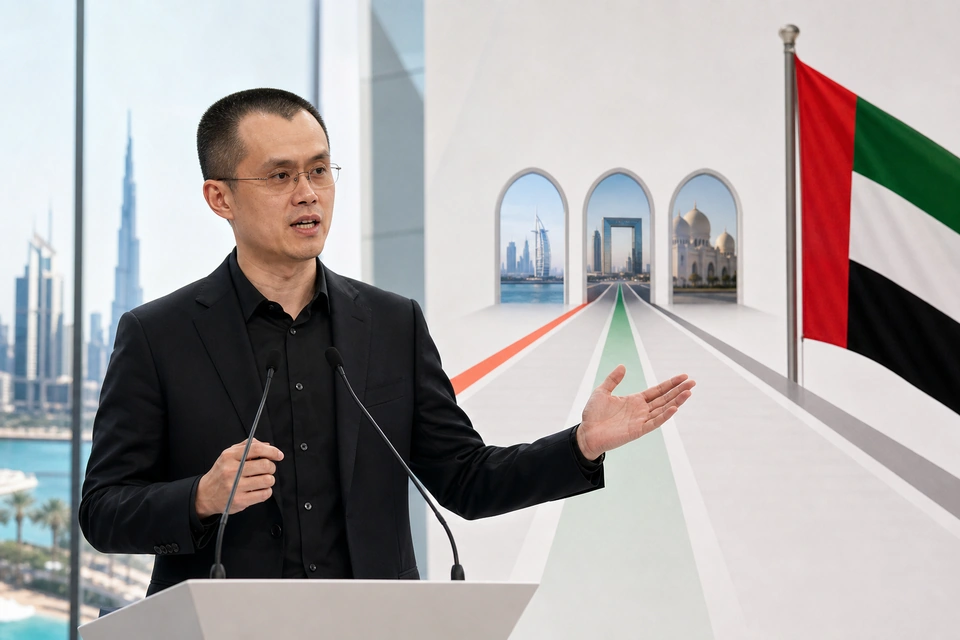
What Changpeng Zhao actually said
Zhao told the Hong Kong audience that countries are taking different routes toward digital assets and selected the UAE as the most progressive current example. The position is consistent with comments he made in May, when he described the Emirates as the world's most crypto-friendly place and credited regulatory clarity and leadership willing to engage with the industry.
That view should not be presented as a proven league table. There is no single method for naming the best jurisdiction: licensing time, banking access, tax, permitted products and customer geography matter differently to each operator. Zhao's experience makes his judgment relevant to the debate, but a founder still needs to test the rules against a specific business model.
Why the UAE can look predictable to crypto firms
The Emirates' central advantage is not an absence of supervision. It is the availability of distinct regulatory routes for different models. Dubai has the specialist Virtual Assets Regulatory Authority, or VARA. The Abu Dhabi Global Market international financial centre operates its own framework through the FSRA. Payment tokens and related services also sit within a federal Central Bank of the UAE regime.
This structure gives firms more information before launch. A product can be mapped to a licensing category and to requirements for capital, custody, governance and financial-crime controls. Multiple regimes also increase the cost of a classification error. Forming a company in a free zone does not by itself authorise every crypto service across the UAE.
VARA, ADGM and the central bank cover different perimeters
VARA regulates virtual-asset activity in Dubai, including special development and free zones, except the DIFC. An exchange, broker, custodian or other provider carrying on a regulated activity in or from Dubai needs the appropriate VARA licence before operating. Virtual-asset marketing is also subject to dedicated rules, so promotional activity is not an unregulated shortcut into the market.
Inside ADGM, financial firms dealing with virtual assets, fiat-referenced tokens, digital securities or related funds and derivatives apply to the FSRA for Financial Services Permission. The central bank's Payment Token Services Regulation has been in force since August 31, 2024 and covers services such as issuance, conversion, custody, transfer and certain payment uses. Licence selection therefore starts with an operational map, not a jurisdictional slogan.
- Dubai outside DIFC: check the VARA licensing perimeter.
- ADGM: identify the regulated activity and required FSRA permission.
- Payment tokens: map the product to central-bank requirements.
- Foreign customers: assess the rules in every target market separately.
Crypto-friendly does not mean restriction-free
The official regimes impose governance, client-asset controls, technology and risk management, and measures against money laundering and sanctions evasion. The central bank's payment-token rules, for example, require licensing or registration and restrict certain asset types. This is a supervised market, not permission to accept funds without understanding the customer and purpose of a transaction.
A UAE licence does not automatically permit a platform to solicit customers in other countries. Cross-border marketing, consumer protection, banking, data requirements and each token's legal status still need separate analysis. Clear local rules can reduce uncertainty, but they do not remove compliance costs, approval timelines or the possibility that an application will be refused.
How to use Zhao's assessment in a real decision
A founder should begin with a precise product description: exchange, brokerage, custody, token issuance, payments, staking or asset management. The next questions are where the activity occurs, who the customers are and how money and assets move. Only then is it useful to compare VARA, ADGM and federal requirements and budget for capital, compliance staff and independent assurance.
For an individual, a jurisdiction's reputation cannot replace verification of the specific platform. Check the operator in the official register, match its legal entity and domain, review the activities covered by its licence and understand the complaint process. Zhao's statement highlights the maturity of the UAE's infrastructure, but a decision to establish a business or transfer funds should rest on the operator's actual authorisation and qualified legal advice.