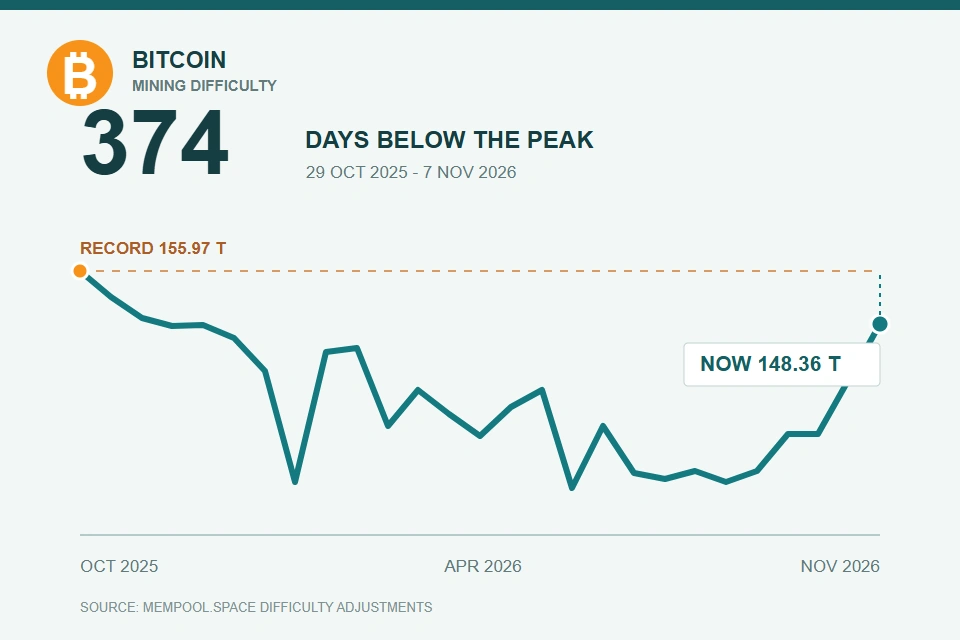

The change recorded at block 975,744
Mempool.space's adjustment history reports difficulty of 148,364,561,003,867.4 at block 973,728 and 134,823,837,323,272.7 at block 975,744. That is a decline of approximately 9.13%. The header of block 975,744 contains the new bits value from which the permitted mining target is derived. These are observable network records, not an analyst's assessment of market sentiment.
The change took effect under Bitcoin's protocol rules. No exchange or individual mining company sets the difficulty manually. Nodes check whether each block meets the expected target, and the network uses the new parameter until the next retarget.
Why Bitcoin retargets difficulty
Bitcoin's developer documentation explains that the target is recalculated every 2,016 blocks. The protocol compares the time taken to mine the preceding period with a two-week reference and aims to bring the average block interval back toward ten minutes. If the period took longer, the target becomes easier; if it took less time, difficulty rises.
Lower difficulty means that, all else equal, a given machine needs fewer attempts on average to find a qualifying block. It does not increase the block subsidy or remove competition among miners. If aggregate computing power changes again, the next period and its adjustment may be different.
A retarget is not evidence of mass capitulation
The network measure is consistent with blocks arriving more slowly than the target pace during the preceding period. It does not identify which companies may have switched off machines or why. BTC prices, electricity rates, hardware, transaction fees and contracts vary across operators. A claim of widespread miner capitulation needs evidence about those operators, not a single difficulty reading.
Leveraged-position liquidations are a separate derivatives-market measure. They cannot be inferred from block headers or difficulty history. A market report may discuss both events together, but timing alone does not establish that liquidations reduced hashrate or that the retarget will move Bitcoin's price.
What users can take from the adjustment
For someone sending a transaction, current mempool demand, fee selection and the actual arrival of new blocks matter more directly. The lower difficulty is designed to adapt the network after the preceding period, but it does not guarantee confirmation of a particular transaction in ten minutes. Individual block intervals remain variable.
The retarget shows that a mechanism built into the protocol operated as intended. It is not a Bitcoin buy-or-sell signal, nor does one observation establish the safety of funds held in a wallet. Subsequent blocks will show how the next period develops; claims about individual miners require their disclosures and economic data.