
What the guilty plea covers
According to prosecutors and the agreed statement of facts, Yaroch worked in the FBI's Boston Division and then in its Counterintelligence and Espionage Division from February 2025 through July 31, 2026. The systems he could access held cryptocurrency credentials collected during investigations.
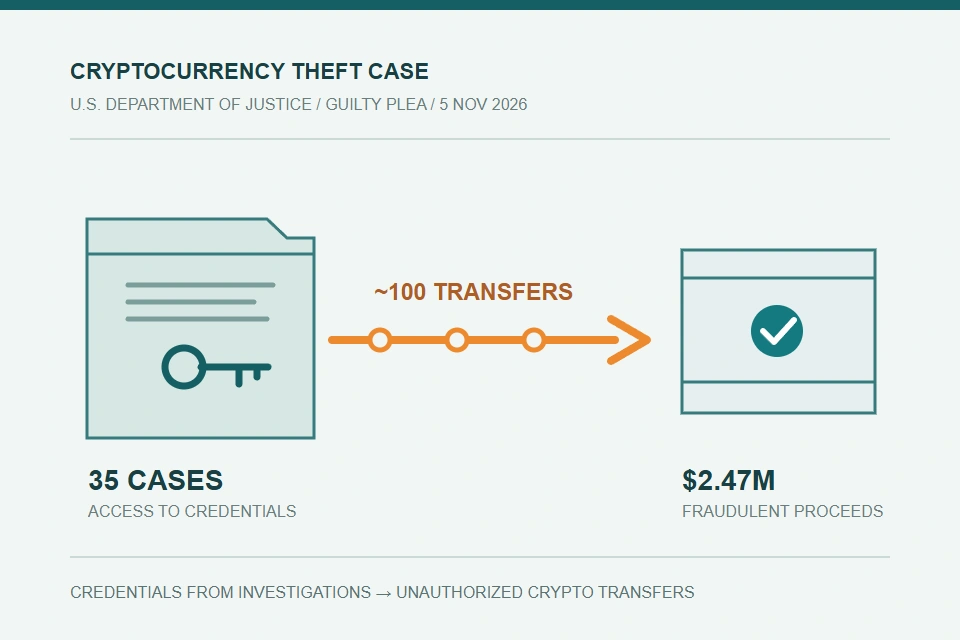
Beginning no later than December 2024, he made unauthorized transfers from wallets controlled by subjects of several investigations or by adversarial nation-state actors, as well as at least one wallet the FBI had created for an operation. The Justice Department describes approximately 100 fraudulent transfers involving 35 investigations and $2,474,380.66 in proceeds. That is the amount cited in the case, not a present-day valuation of the stolen coins.
The route the funds took
After moving the assets, Yaroch exchanged them for other cryptocurrencies and used further financial transactions to obscure their source and ownership, prosecutors said. Their statement identifies about $93,082 transferred to one of his accounts between November 25, 2025 and January 13, 2026. The funds then moved among his accounts and helped pay debts, including credit cards and loans.
Court documents also describe plans for a move to Portugal. After ChatGPT suggested buying a vineyard, Yaroch gave lawyers power of attorney for Portuguese tax registration and arranged travel. The Justice Department does not say he bought a vineyard. Those details concern his intended use of the proceeds; they do not establish an additional completed purchase.
The damage beyond the transfers
The agreed statement of facts cited by prosecutors says Yaroch's conduct compromised investigations involving criminal groups and foreign state adversaries, as well as FBI sources and methods. The consequences therefore cannot be reduced to the dollar value of transfers. The public release does not list every wallet, chain or address, so it does not support independent attribution of each transaction.
The case illustrates the risk when a staff member lawfully encounters wallet secrets in an investigation: an on-chain record of a transfer cannot prevent someone with a usable credential from initiating it. Access limits, separation of duties and transaction review matter regardless of who owns the asset. Those are general lessons, not claims about the FBI's specific custody architecture.
What happens next
A federal judge accepted the plea on wire fraud and money laundering. The Justice Department says Yaroch faces a maximum of 20 years in prison, not that such a sentence has already been imposed. The court is scheduled to sentence him on March 4, 2027 after considering the applicable guidelines and case-specific factors.