The IMF Board has not completed the reviews
A staff-level agreement is a preliminary understanding between the IMF team and the national authorities. It remains subject to agreed prior actions and approval by the Executive Board. If those steps are completed, El Salvador would gain access to about $140 million under the Extended Fund Facility arrangement.
The announcement therefore contains two distinct developments. IMF staff accepted the documentation-based explanation for purposes of their review, while the review itself still awaits a Board decision. Combining those stages would overstate the release as a final audit opinion.
A private donation is not a budget purchase
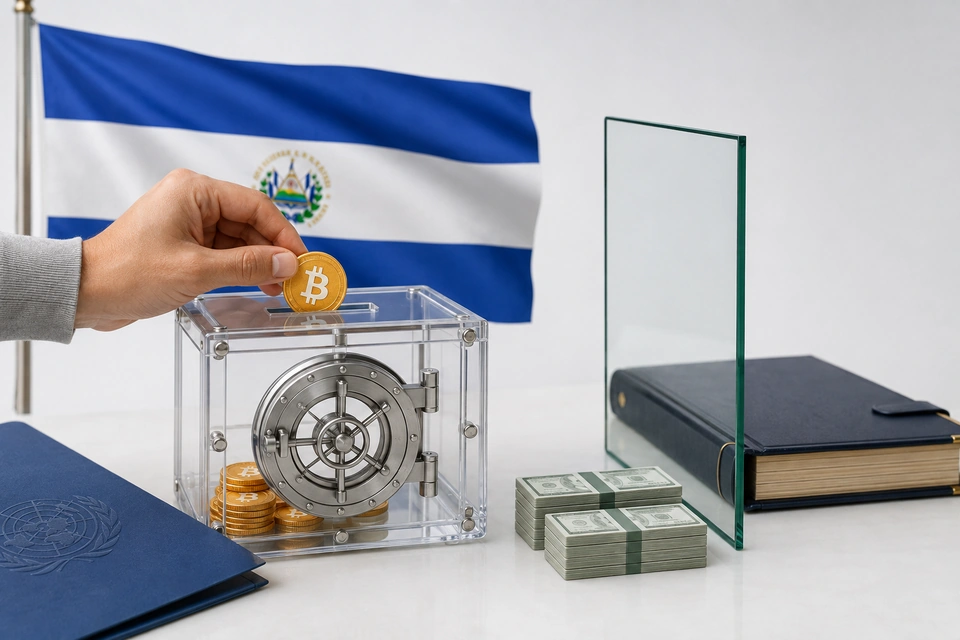
The IMF's wording is narrow: Bitcoin accumulation since the first review reflects private donations, and no public resources were used. The source of financing and the ultimate ownership of an asset are separate questions. Coins can enter public-sector control without a payment from the government budget.
The public release does not identify donors, list the relevant transactions, state transfer values or describe how each document was matched to a wallet. Readers cannot independently reconstruct every transfer from the announcement. What is established is the IMF staff statement about documentation they reviewed, not a publicly available tracing of the entire funding chain.
The Fund also says no further accumulation beyond the documented donations is expected. That is a program expectation. It is not a technical restriction on incoming transfers to a known address, nor a guarantee that every wallet balance will remain fixed.
The blockchain records transfers, not funding labels
El Salvador's official Bitcoin Explorer publishes addresses, balances and transactions. Those records can establish that a UTXO appeared and when coins moved. The blockchain itself does not identify the economic funder, classify a transfer as a donation or determine which public body recognizes the asset in its accounts.
Those classifications require off-chain evidence such as agreements, accounting records, proof of address control and the IMF program's definitions. A higher aggregate wallet balance therefore does not, by itself, answer whether the budget paid for the coins. It shows observable BTC under a stated control framework, not the complete provenance of the funds.
A dollar valuation needs another qualification. It can change with the market price even when no Bitcoin moves. The quantity of BTC, the source of an addition and the current dollar value should be tested as separate measurements.
Chivo's transfer is separate from reserve ownership
The same IMF release says public participation in the Chivo wallet has been substantially unwound. Majority ownership and operational control moved to a private operator, while the government retained a minority stake and custodial responsibilities for customer assets.
That does not make every public Bitcoin asset private. Chivo customer funds, an equity interest in the operator and a sovereign reserve serve different purposes and follow different accounting rules. Custody is also not the same as economic ownership: an entity may control keys or infrastructure without owning the customer's asset.
The IMF separately identified further work on digital-asset regulation and stronger governance and risk management for public-sector crypto holdings. A change in operational control consequently does not close the transparency and oversight questions around the reserve.
The first review supplies the baseline
The IMF Executive Board approved the 40-month, roughly $1.4 billion arrangement on February 26, 2025, and completed the first review on June 27. The policy package included voluntary private-sector acceptance of Bitcoin, US-dollar-only tax payments, reduced public participation in Chivo and a commitment to keep public-sector Bitcoin holdings unchanged.
The first-review report had already shown why balance movements need context. Small deviations from the accumulation criterion were attributed to fluctuations in Chivo customers' BTC deposits rather than an announced government purchase. Once the public sector exits operational control of the wallet, accounting boundaries also change, so comparisons need a consistent definition of the public sector.
The latest release adds an explanation for the period after that baseline: the documentation points to donations. A fuller assessment should arrive in the staff report if the agreement clears internal approval and proceeds to the Board.
What the announcement tells a Bitcoin holder
The confirmed point is limited to the IMF's position. Its staff say reviewed documentation links the additions to private donations and excludes the use of public resources. The release does not publish a complete audit of addresses or establish what this funding model should mean for Bitcoin's market value.
The development matters for evaluating fiscal exposure, transparency and El Salvador's compliance with its lending program. It is not a reason to buy or sell BTC. Even a large donation does not establish recurring demand without a repeatable source and a schedule of future transfers.
Three disclosures will matter next: the IMF staff report, the Executive Board decision and updated information on controlled wallets. Together they can better separate the public balance from its funding source and show how the new Chivo structure is reflected in government reporting.